Almost every Indian Army officer of my father's generation, and most who came after, had read Philip Mason's A Matter of Honour1, usually more than once. Fewer had gone on to the two volumes he had written earlier under the name Philip Woodruff, his mother's maiden name, The Men Who Ruled India2, which did for the old Indian Civil Service what A Matter of Honour later did for the Army. Somewhere in those pages Mason speaks of the majesty of governance. The phrase has stayed with me for years, partly because it sounds faintly imperial and partly because its meaning is almost the opposite of imperial power. It suggests that there is something larger than the authority of the man who occupies the chair, something that resides in the institution itself, in the manner in which power is exercised and, most importantly, in the confidence of the people who live under it.
It is not the same thing as power. Power can be displayed; governance has to be lived. Every Republic Day we put power on display with great gusto. Tanks roll down Kartavya Path3 beneath a pale winter sun, missiles glide past on their carriers, contingents march in immaculate formation towards India Gate and, at the end, aircraft come low over Raisina Hill while the entire avenue tilts its head upwards to watch.4 It is magnificent theatre, and there is nothing wrong with it when it celebrates what a country has built and what its people have sacrificed to defend. Yet somewhere within that spectacle lies a confusion that has become increasingly common in the Indian mind. The soldier on a frozen post along the Line of Control, the jawan of the Central Armed Police Forces standing guard at a difficult frontier5 and the policeman waving traffic through the fumes at ITO are all gathered together under the convenient phrase “the security forces”, as though the uniform itself were the institution. It is not. Their constitutional responsibilities are different6, their training is different, their relationship with the citizen is different and, perhaps most importantly, the circumstances in which the citizen encounters them are completely different.
The soldier is usually encountered at a distance, and often at his best. The citizen sees him in a flood, on a landslide scarred mountain road, at an airport during an emergency, or on the evening news standing against the wind on some distant pass. The policeman is different. He is the uniform most citizens actually meet. He is at the traffic junction, in the police station, outside the court, at the protest, on the road accident site and sometimes at the door of a house on the worst evening a family has known. The citizen does not usually meet the Army when everything has gone wrong in his own life; he often meets the police precisely because something has. Institutions acquire their reputations not from the speeches made about them but from the accumulated experience of the people who encounter them.
The theatre of the Raj
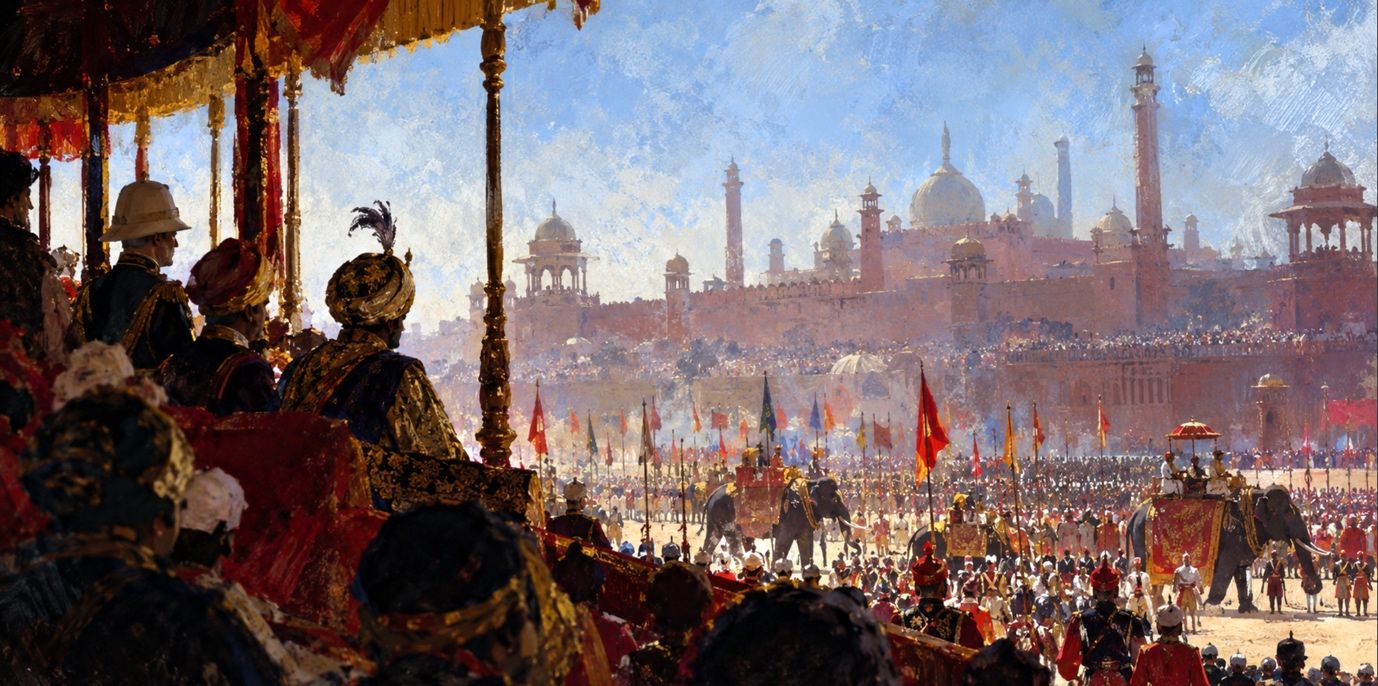
The Delhi Durbars were designed to awe the governed, which, lest we forget, meant us.7 So was much of the stone that went with them. Lutyens’ Viceroy’s House, now Rashtrapati Bhavan, crowns Raisina Hill in red and cream sandstone8, while Baker’s Secretariat buildings flank the approach like enormous courtiers.9 The architecture was not accidental. The Raj understood the theatre of authority and the distance it could create between the governed and those who ruled them. The hill, the Durbar, the uniforms, the ceremonies and the buildings all reinforced the same message: authority stood above you.
That world disappeared at midnight in August 1947.10 The white man in his solar topee evaporated from the machinery of government and, within a few years, the chairs of authority were occupied by people who were unmistakably us.11 The collector, the police superintendent, the brigade commander and the citizen being governed now came from the same country, often from much the same social world and sometimes from the same schools. The line between those who governed and those who were governed had, in theory, disappeared. Yet physical structures change much faster than institutional habits. The sandstone remained, the files remained, the desks remained and the uniforms remained, and some of the distance that had once been created deliberately by an imperial system survived in places where the Republic had no reason to preserve it.
It survives most visibly in the places where citizens actually meet the State. It is there in the dim police station with its peeling walls and fat registers, in the government office where a file appears to have acquired geological permanence, in the passport office where a missing signature can turn a straightforward application into a pilgrimage and in the district court where a citizen can spend an entire day waiting for his name to be called. Every country has imperfect institutions. The deeper problem begins when the citizen believes the institution was never really designed for him, that the rules are negotiable for those with influence and immovable for those without it, and that somewhere behind the desk sits a small piece of the old Raj still convinced that authority means keeping people at a distance.
What majesty means in a Republic
This is where the idea of the majesty of governance becomes important, because majesty in a Republic cannot mean intimidation. It cannot reside in the height of the official’s chair, the size of the minister’s convoy, the volume of the policeman’s voice or the number of people who stand when an important person enters a room. Those are merely the visible accessories of power. The real majesty of governance is quieter and much harder to manufacture. It is the confidence that the institution will work when you need it, that a complaint will be recorded because the law requires it12, that an application will move because the documents are in order, and that the official understands that he is there to discharge a public responsibility rather than dispense a personal favour.
At its simplest, institutional integrity means that an institution behaves in essentially the same way whether or not anyone important is watching. Institutions are not the buildings in which they work, nor the seals on their documents, nor the uniforms worn by their officers. They are habits accumulated over generations: the expectation that a rule applied today will still be applied tomorrow, that a citizen without influence has the same claim upon the State as one who has it, and that authority belongs to the institution and is merely entrusted to the officer for a while.
Power can be displayed; governance has to be lived.
That is why criticism of institutions should never automatically be treated as an attack upon the State. A healthy institution must be capable of being questioned and able to absorb criticism without becoming defensive. The policeman who takes a bribe must answer for taking it. The officer who misuses force must answer for doing so. The civil servant who abuses his authority must answer for that abuse, and the commander who makes a grave professional error must be examined with the same seriousness. A government that misuses an institution or leaves it unreformed for political convenience must accept responsibility for that choice. The ability to distinguish between an institution, the individual temporarily exercising authority within it and the system that permits a failure to become routine is one of the marks of a mature Republic.
The opposite danger is just as serious. Institutional loyalty can become a convenient shield against institutional accountability. Once an organisation begins to believe that criticism of one of its members is criticism of the organisation itself, protecting its reputation can become more important than correcting its mistakes. That is not institutional strength. It is institutional fragility wearing the uniform of authority. An institution that cannot acknowledge failure will eventually repeat it, and an institution that demands unquestioning loyalty from the citizen will eventually discover that obedience and confidence are not the same thing.
The police provide perhaps the clearest example because they stand at the point where the citizen and the State meet most frequently. Much of Indian policing still carries the inheritance of a system created under colonial rule to maintain order rather than to serve citizens.13 That history does not explain every failure and certainly does not excuse misconduct, but it does explain why reform is more difficult than changing a few regulations or issuing another circular from Delhi. Systems acquire habits, and habits acquire defenders. A policeman working fourteen hours14 in the heat, short of manpower, equipment and sleep, can still behave badly and must still answer for it. But the fact that an individual has failed does not mean that the system which placed him in that situation is irrelevant. Understanding the conditions under which institutions operate is not the same thing as excusing what they do.
The policeman, after all, is also part of the people, drawn from the same towns and villages as the citizens he is expected to control, protect or assist. He may be exhausted, frightened or badly trained. He may also be corrupt, violent or indifferent. Both possibilities can exist at the same time, which is precisely why institutional questions cannot be reduced to simple morality tales in which the citizen is always virtuous and the uniform is always guilty, or the uniform is always honourable and the citizen is always unruly. The uniform marks the particular burden one citizen has accepted on behalf of the rest.
Courage is not enough
That distinction is particularly important when we turn to the armed forces, because military history offers perhaps the clearest demonstration of what happens when individual courage encounters institutional weakness. Military history is too often reduced to battles, weapons and famous commanders, when in reality it is the study of institutions under the most extreme pressure human beings can place upon them. It is what happens when political decisions meet geography, ambition meets logistics and intelligence meets uncertainty, with the cost of mistakes eventually measured in human lives.
Go to Namka Chu or Rezang La and the argument becomes almost physical. The mountains there are not merely backdrops to history. They are part of it. At those altitudes the air itself becomes an adversary, the cold enters the metal of weapons and the human body begins to understand that the Himalaya does not care about national boundaries or military plans. Men of 2 Rajput15, 13 Kumaon16 and countless other units went into those mountains with the same limitations of flesh and blood that every soldier carries, and many stayed there until they could stay no longer. Courage was not what India lacked in the winter of 1962.17
What failed was much of what stood behind the man on the hill: intelligence, logistics, higher command and political direction.18 The lesson of 1962 is therefore not simply that soldiers fought bravely, though many did. It is that individual courage cannot permanently compensate for institutional weakness. An Army does not fight because a collection of brave men wakes up one morning and decides to be brave. It fights because generations of training, doctrine, discipline, logistics, leadership and regimental tradition have created a system in which an ordinary young man can perform an extraordinary act with some reasonable expectation that the system behind him will also do its duty.
Courage was not what India lacked in the winter of 1962.
The citizen at a police station and the soldier on a Himalayan ridge inhabit different worlds, yet both depend upon something similar: knowing that the institution behind them will function when it matters. The soldier cannot carry ammunition that the logistics system failed to deliver, just as the policeman cannot be expected to maintain public order indefinitely with inadequate training, insufficient manpower and institutions designed for another age.
Systems therefore matter, but systems are not machines that run by themselves. They are sustained by leadership, professional culture, accountability and the willingness to correct what is not working. A good institution is not one that never makes mistakes. That institution does not exist. A good institution is one in which mistakes can be recognised, responsibility can be established without scapegoating and lessons can be absorbed before the same failure returns wearing a different uniform.
The lines we draw
This is where power and governance part company. Power can compel obedience for a considerable length of time; governance depends upon something more difficult, which is confidence. A government may have every legal right to order the police to clear a road, and the police may possess every authority necessary to do so. The question that matters afterwards is what happened to the institution in the process. Did the citizen see the State exercising lawful authority, or did he see force being used because force was easier than persuasion? The physical road may be cleared in either case. The institutional consequences will be very different.
This is why restraint is as much a component of strength as force. It requires governments capable of admitting failure without treating criticism as an assault upon the nation, and institutions capable of correcting themselves without waiting to be shamed. It requires a policeman who understands that maintaining order does not require contempt for the people whose order he is maintaining, just as it requires a citizen to understand that the right to dissent does not include the right to assault another citizen or destroy public property.
The Republic cannot borrow the majesty of the Raj because the Republic rests upon an entirely different relationship between the State and the citizen. Imperial authority depended upon distance. Republican authority depends upon legitimacy, and legitimacy has to be renewed every day in thousands of ordinary encounters. It is renewed when the clerk processes the application correctly, when the constable records the complaint, when the judge hears the case, when the officer refuses an improper order and when the commander accepts responsibility for a decision that has gone wrong. None of these moments is spectacular. Taken together, they are what hold a Republic together.
But perhaps the most important responsibility lies even earlier, with us. We, the People,19 cannot leave the parameters of acceptable public conduct undefined and then complain when institutions cross them. A Republic needs lines. It needs to know what is permissible, what is unacceptable and what must never become normal, whether the transgression comes from a citizen, a policeman, a bureaucrat, a soldier, a commander, a minister or the State itself. Those lines cannot be elastic simply because the person crossing them is powerful, popular or useful. Once a democratic society has drawn them through its laws, institutions and constitutional values, they must become sacrosanct.
That, ultimately, is the majesty of governance. Not the ruler standing above the citizen, not the uniform intimidating the crowd, not the State demonstrating how much power it possesses, but a Republic confident enough to establish its own standards and disciplined enough to hold itself to them. We, the People, are not merely the governed. We are the authors of the compact. The lines we draw are the lines by which power itself must be measured. And once we have drawn them, no office, no uniform and no authority should stand above them.
Notes
- Philip Mason, A Matter of Honour: An Account of the Indian Army, Its Officers and Men (London: Jonathan Cape, 1974). ↩
- Philip Woodruff [Philip Mason], The Men Who Ruled India, vol. 1, The Founders (London: Jonathan Cape, 1953), and vol. 2, The Guardians (London: Jonathan Cape, 1954). Mason’s maternal grandfather was Herbert Addison Woodruff, and as a boy he called himself Philip Woodruff Mason: Philip Mason, A Shaft of Sunlight: Memories of a Varied Life (London: André Deutsch, 1978), 3–5. ↩
- Rajpath, earlier Kingsway, was renamed Kartavya Path when the Prime Minister inaugurated it on 8 September 2022: Press Information Bureau (Prime Minister’s Office), “PM inaugurates ‘Kartavya Path’ and unveils the statue of Netaji Subhas Chandra Bose at India Gate,” 8 September 2022, pib.gov.in (accessed 30 September 2026). ↩
- On the parade’s tanks, missiles and closing fly-past, see Press Information Bureau (Ministry of Defence), “77th Republic Day Parade: Kartavya Path set to unveil unique mix of 150 years of ‘Vande Mataram’ and the nation’s progress & military might, immersed in rich cultural diversity and Jan Bhagidari,” 25 January 2026, pib.gov.in (accessed 30 September 2026). ↩
- The Border Security Force guards the borders with Pakistan and Bangladesh, the Indo-Tibetan Border Police the whole India–China border, the Sashastra Seema Bal the borders with Nepal and Bhutan, and the Assam Rifles the border with Myanmar: Ministry of Home Affairs, Police-II Division, “Introduction,” mha.gov.in (accessed 30 September 2026), 2, 4, 9, 13. ↩
- Defence and the armed forces are Union subjects; public order and police are State subjects: Constitution of India, Seventh Schedule, List I, entries 1, 2 and 2A, and List II, entries 1 and 2, in The Constitution of India (New Delhi: Legislative Department, Ministry of Law and Justice, 2022), 310, 317, PDF (accessed 30 September 2026). ↩
- On the Durbars of 1877, 1903 and 1911 as “pageants of power, prestige, and authority,” see Sonakshi Goyle, “Tracing a Cultural Memory: Commemoration of 1857 in the Delhi Durbars, 1877, 1903, and 1911,” Historical Journal 59, no. 3 (September 2016): 799–815, doi.org/10.1017/S0018246X15000424. ↩
- The official account describes the building’s stone as “pink and cream sandstone”: Rashtrapati Bhavan, “Making of Rashtrapati Bhavan,” rashtrapatibhavan.gov.in (accessed 30 September 2026). ↩
- Herbert Baker built the North Block and the South Block: Rashtrapati Bhavan, “The President’s Secretariat & Making of Rashtrapati Bhavan,” rashtrapatibhavan.gov.in (accessed 30 September 2026). ↩
- Indian Independence Act 1947 (10 & 11 Geo. 6, c. 30), s. 1(1), which created the two dominions “as from the fifteenth day of August, nineteen hundred and forty-seven”: legislation.gov.uk (accessed 30 September 2026). ↩
- In the Army, for example, General (later Field Marshal) K. M. Cariappa took over from General Sir F. R. R. Bucher, the last British Commander-in-Chief, in 1949: Press Information Bureau (Ministry of Defence), “Indian Army Celebrates 74th Army Day,” 15 January 2022, pib.gov.in (accessed 30 September 2026). ↩
- The Supreme Court held that registering an FIR for a cognizable offence is mandatory: Lalita Kumari v. Government of Uttar Pradesh, [2013] 14 S.C.R. 713, 800, para. 111(i) (12 November 2013), PDF (accessed 30 September 2026). The duty is now in section 173 of the Bharatiya Nagarik Suraksha Sanhita, 2023. Section 173(3) allows a preliminary enquiry of up to fourteen days, with the permission of an officer not below the rank of Deputy Superintendent of Police, for offences punishable with three years or more but less than seven years: Gazette of India, Extraordinary, Part II, section 1, 25 December 2023, 52–53, PDF (accessed 30 September 2026). The Sanhita came into force on 1 July 2024: Press Information Bureau (Ministry of Home Affairs), “New Criminal Laws,” 10 December 2024, pib.gov.in (accessed 30 September 2026). ↩
- The police system’s roots in the Police Act of 1861 were set out by the petitioners in Prakash Singh v. Union of India, (2006) 8 SCC 1, judgment of 22 September 2006, indiankanoon.org (accessed 30 September 2026). ↩
- A survey of nearly 12,000 police personnel in 21 States found that they work an average of 14 hours a day: Common Cause and Lokniti–CSDS, Status of Policing in India Report 2019: Police Adequacy and Working Conditions (New Delhi: Common Cause and CSDS, 2019), 12, 46, PDF (accessed 30 September 2026). ↩
- On 2 Rajput’s stand at the Namka Chu on 20 October 1962, where Major B. K. Pant’s force of 112 men “had 82 killed and wounded,” see J. P. Dalvi, Himalayan Blunder: The Curtain-Raiser to the Sino-Indian War of 1962, 2nd ed. (Bombay: Thacker, 1969), 370–71. Brigadier Dalvi commanded 7 Infantry Brigade in that battle. ↩
- Charlie Company of 13 Kumaon defended Rezang La on 18 November 1962: Press Information Bureau (Ministry of Defence), “Raksha Mantri Shri Rajnath Singh dedicates to the Nation renovated Rezang La Memorial at Chushul in Ladakh,” 18 November 2021, pib.gov.in (accessed 30 September 2026). ↩
- The war was fought from 20 October to 20 November 1962: “Sino-Indian War,” Encyclopaedia Britannica, britannica.com (accessed 30 September 2026). ↩
- Dalvi called 1962 “a failure in the Higher Direction of War”: Dalvi, Himalayan Blunder, xv. On logistics, leadership and the “knowledge gap about China,” see Bhartendu Kumar Singh, “Henderson Brooks Report and India’s China Challenge,” Journal of the United Service Institution of India 142, no. 591 (January–March 2013): 72–73, PDF (accessed 30 September 2026). ↩
- The Preamble to the Constitution of India opens “We, the People of India.” ↩
No comments yet. Be the first.
Loading comments…